
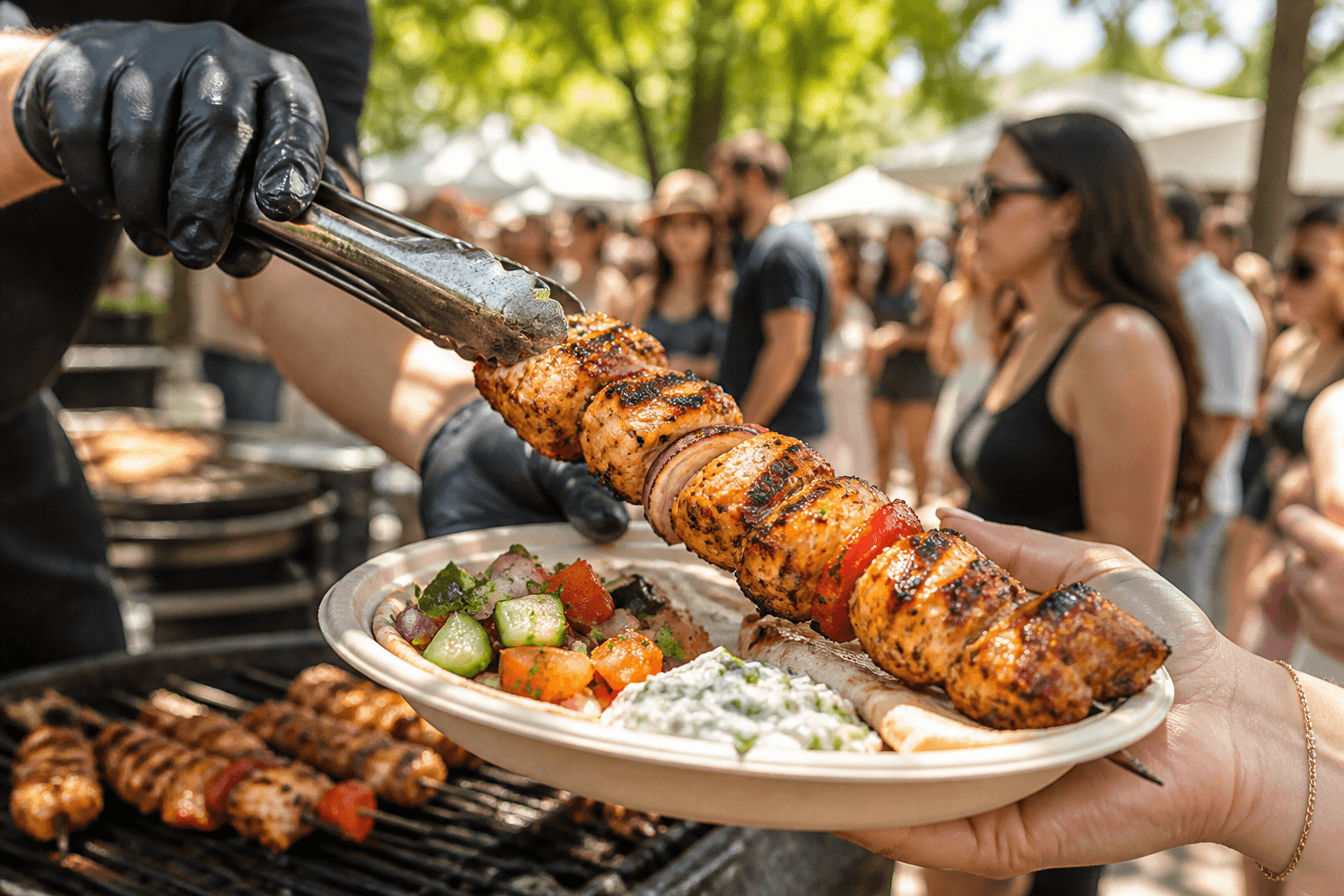
Your signature is a sequence, not just a recipe
Street food is theatre, but the audience is often watching while holding a suncream-covered child and checking whether the queue is moving. Your dish needs a clear rhythm:
- Base: the thing that carries flavour and structure
- Main element: grilled, fried, roasted or assembled to order
- Acid or freshness: something that lifts the richer parts
- Final texture: crunch, drizzle, herbs or seasoning added at the last possible moment
That final element matters more than operators sometimes admit. A fried topping mixed through too early becomes a damp apology. A sharp pickle added at the counter can make a rich sandwich taste brighter. A sauce brushed on before wrapping can soak in beautifully — or turn the bread into a napkin.
Think of your signature as having a best-before moment measured in minutes, not days. The aim is not to stop change completely. It is to control it.
Design for the five-minute truth
During summer service, food may sit in the pass while a customer finds their friends, waits for a drink, or negotiates a buggy through a festival crowd. Test your dish under that reality.
Make one portion and taste it:
- Immediately
- After five minutes in its takeaway packaging
- After ten minutes
- After being carried around in one hand
Notice what fails first. Is the bread steaming itself soft? Is the sauce splitting? Has the salad wilted? Has the hot filling cooled because it is overloaded with cold garnish?
Then adjust one variable at a time. You might:
- Put wet ingredients in a separate pocket rather than directly against bread
- Use pickled vegetables for brightness without a bowlful of raw, watery salad
- Add crunch at handover, not during bulk prep
- Reduce the size of a garnish that looks generous but collapses quickly
- Choose packaging that vents steam instead of trapping it
This is craft, not corner-cutting. A dish that arrives in good condition is more memorable than one that looked spectacular for 30 seconds at the pass.
Build a summer signature around contrast
Heat changes how customers experience flavour. Richness can feel heavier, while cold, sharp, herbal or juicy components become more valuable. That does not mean every menu needs to become a salad. It means your hero item should have contrast.
Try pairing:
- Crisp with soft
- Charred with fresh
- Rich with acidic
- Warm with cool
- Familiar with one distinctive ingredient or technique
The signature should also be recognisable from several feet away. At a wedding or busy festival, customers make fast decisions. A bold finishing colour, a particular fold, a visible skewer, or one unmistakable aroma can do as much marketing as a chalkboard.
Just make sure the flourish earns its place. If a garnish slows assembly, falls off in transit or requires a separate explanation at every order, it may be theatre without much payoff.
Make the queue part of the story
People will wait more happily when they can see progress. Keep the most satisfying action visible: the final toast, glaze, sprinkle or squeeze. Batch the slow work behind the scenes, then reserve one quick, repeatable finishing move for each order.
For wedding service, consistency matters more than improvisation. Guests may be eating at different times, and the couple’s carefully planned menu deserves a dish that looks and eats properly from the first plate to the last. For school-holiday crowds, speed and sturdiness win: fewer drips, fewer confusing choices, and something children can manage without wearing half of it.
Two things to do this week
Run a ten-minute signature test. Use your real packaging, portion size and service setup. Record the first point where texture or temperature noticeably drops, then change one component to fix it.
Create a “last-touch” rule. Decide which element must be added at handover — sauce, crunch, herbs or seasoning — and train every crew member to do it the same way.
The best summer street food is not merely delicious at the counter. It stays delicious while the customer walks away, finds a bench and takes the first bite. That is where a recipe becomes a signature.